

Hello, friends!
As parents, we often wonder how we can help our children grow—not only in their learning but also in their faith. The good news is that both language learning and devotional time don’t have to feel like extra tasks to add to an already busy schedule. So, I would love to help you encourage your children to learn a new language at home, alongside things you are already doing! They can flow naturally into your daily life, becoming joyful moments of connection with your child. And most importantly, you can use the Word of God to help them learn the new language one verse at a time!
Here are some simple ways to weave both into your family’s rhythm:
1. Start Small and Be Consistent
Children thrive on routines. Choose a time when your family naturally slows down—bedtime, breakfast, or after dinner—and dedicate just a few minutes to read a Bible verse together. If the verse is in two languages, like in My Book of ABC Bible Verses, repeat it in both. Then, have them repeat each word slowly after you. Repetition throughout the week will help your child remember both the words and the message.
2. Use Everyday Opportunities
Faith and language can be nurtured in the simplest moments. While getting dressed, say “God made you wonderfully!” in Portuguese and English. At mealtimes, pray a short blessing in one language, then in the other. Give your children the opportunity to pray with you or after you. These little reminders will be an anchor for their faith and an important tool in their language-learning process.
3. Make It Playful
Children learn best when they’re having fun. Try acting out Bible stories together, drawing pictures of the verse of the day, playing charades with the main words, or singing Scripture songs in the two languages. Make a game of memorizing verses with hand motions, or point out objects and words learned in the verse as you go about your day. When it’s playful, it sticks!
4. Celebrate Each Small Progress
Whenever your child remembers a verse or says “thank you” in the second language, pause to celebrate. This will teach them that learning and spiritual growth are not chores but joys worth treasuring.
5. Tie Language to Faith Lessons
One beautiful benefit of bilingual devotionals is that they show children how God’s Word reaches across cultures. Remind your child that people all over the world read and pray the same Bible verses in many different languages. This will help them see language learning not just as skill-building, but as part of God’s gift that connects them to a global family.
6. Be an Example
Children notice what excites us. If they see you enjoying reading, praying, and even learning new words yourself, they’ll want to join in. Your joy becomes contagious.
Blending devotional time with language learning is about more than study—it’s about nurturing your child’s heart and mind at the same time. With a little creativity and consistency, your home can become a place where faith and language learning grow side by side.
Praying for your journey,
Erika
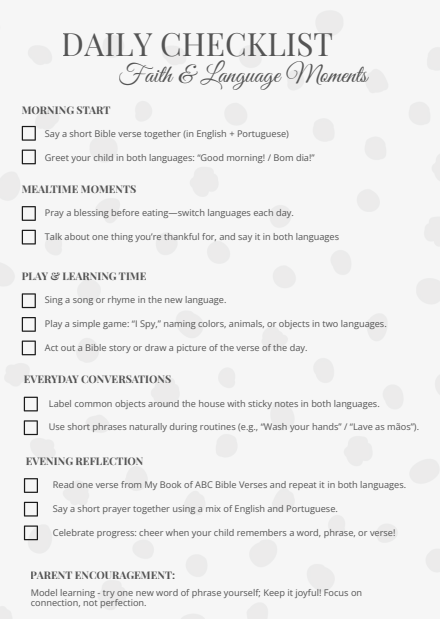
P.S. Check out this Daily Checklist for Ideas on how you can have language & faith moments at home each day!
 EN
EN  PT
PT